
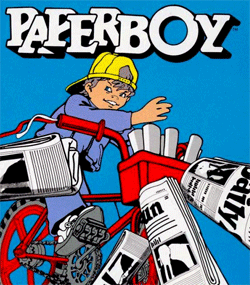
 Since medieval times, children riding mountain bikes around housing estates have
been the traditional English method of buying drugs, guns, and litters of
dangerous dogs. Happily, across the Atlantic, things are very different. In
America, children are healthy, hearty, cheerful, and consider a lithe physique
and an excellent well rounded education to be the foundation stones of a happy,
productive society. It for this reason that Paperboy, released by
Atari in 1984, finds the titular hero delivering Scientific American
around Southern California rather than dumping Inside TV in a canal in
Leeds.
Paperboy is a very novel game. For a start, the player views the
action via cabinet projection. If you know your perspectives, you’ll know that
this differs from the more usually seen cavalier projection in that the length
of the receding lines is halved. Ambitiously, Atari designed the game to be
played via a controller fashioned into the shape of a set of handlebars.
Slightly crazily, the paperboy needs to be in constant motion to avoid swarms of
bees appearing from nowhere and killing him. Newspapers are delivered by
hurling them at the houses of subscribers, which are highlighted on a street map
shown at the beginning of each stage. If you fancy it, you can vandalise
non-subscriber houses for extra points. This somewhat passive-aggressive
method of attracting new business seems to work, however, as there are more and
more newspapers to deliver as the stages progress. The player is able to
choose the difficulty level of each stage – Easy Street, Middle Road and Hard
Way – and aims to deliver papers flawlessly for an entire week.
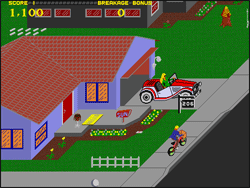 Tribulations come in many forms for the gallant youth. He’ll lose a
life if any of the following things happen: the aforementioned lapses in
pedalling, hitting a drain, hitting a fire hydrant, running into a breakdancer
(well, this is 1984), getting caught up in a tornado, being mauled by a
giant house cat, being attacked by early morning drunks, or, most prosiacly of
all, being touched by the Grim Reaper. Delivering newpapers inaccurately
(hurling one through the living room window by accident, for example) will
result in loss of subscribers, although the Grim Reaper and wandering drunks can
be clobbered with a skilfully hurled periodical for bonus points. It’s not a
simple matter of charging around the neighbourhood, either. As the paperboy
can only carry a set number of newspapers – ten – additional bundles are located
around the neighbourhood, usually in tricky parts of the map.
The
training course, which occurs at the end of each stage and sees the player
hurtling around the map performing simple tricks and jumps for various bonuses,
is a slightly awkward part of the game. While this did not detract from play,
it added nothing either, and was later revealed to be merely an early version of
the game which was bolted onto the finished version because there seemed no
other way of introducing bonuses into regular gameplay.
Snippets of
Paperboy cropped up regularly in popular culture for the next decade or
so, most notably in an episode of something called Captain N: Games
Master, which saw the central character renamed Julio and delivering
newspapers to raise money for the family coffers, blighted after his father lost
his job. It also featured in the likeable early ’90s British geekfest
coincidentally also called Games Master, which featured the disembodied
head of astronomer and lovely old buffer Patrick Moore dispensing gaming advice
to 13 year olds.
So that’s Paperboy, a curiously cool game
which created and then filled a niche so perfectly that it was never widely
copied. Get your cycle clips on and download a copy now.
1 Comment
thanks i love this game!