
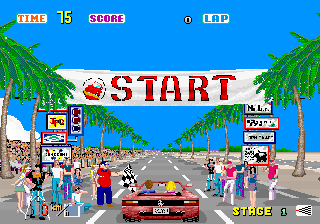
 A couple of weeks ago we spoke about – yes, that’s right – isometric projection and the way it vaguely brought a kind of 3Dish feel to the yawn-smothering delights of Zaxxon (see ‘The angles and the Zaxxons‘, June 21st.) An altogether more exciting gobbet hurled from the bubbling white hot cauldron of mid-80s gaming evolution was sprite scaling. This was a technique that allowed hitherto sluggish sprites to be chucked about all over the place nice and quickly, giving a far greater feeling of 3D movement and, above all, speed. Not only this, but the word on Arcade Street was of something called force feedback. This was an innovation which allowed player interface objects – such as, for example, steering wheels – to judder violently in time with game events – such as, for example, accidentally driving off a road at high speed. With breakthroughs like this going on, it wouldn’t be long before someone gave the world a top notch driving game. Sega were all over it.
It is commonly assumed that the car in which you are going for a gentle yet terrifying spin is a Ferrari Testarossa. It isn’t. Sega had licensing issues with Ferrari from the off, but there are other bona fide vehicles for you to dodge and charge past: a Volkswagon Beetle, a Chevrolet Corvette, a Porsche 911 and a BMW 325i Cabriolet, as well as a somewhat less exciting delivery truck. You did this against a variety of backdrops – and this was where the sprite scaling really came into its own – such as Cloudy Mountain, Seaside Town and Lakeside (now a shopping centre just off Junction 30 of the M25.) It was this ability to create vivid and seperate identities for each stage that was one of the hallmarks of Out Run. Driving through Seaside Town actually made you want to pull over, get some chips, and eat them on the pier, even if this did mean losing a time bonus. Brilliantly, players could switch zones at forks in the road, allowing for an agreeable amount of freedom. Great stuff.
We haven’t mentioned the soundtrack yet. You could choose it. Oh yes. Well, you could choose between four jazz-fusioney compositions, called things like Magical Sound Shower and Passing Breeze. Thoughtfully, the original arcade renderings were supplied in now-defunct cassette format for the home player to listen to as he roared around Coconut Beach and Death Valley, as the ZX Spectrums, C64’s, Amstrads and Atari ST’s that were the backbone of home gaming at the time would probably have melted under the strain of providing so much excitement. Sega had an actual band at the time – the SST Band – and the Out Run soundtracks were penned by one of the members, Hiroshi Miyauchi. The SST band wrote music for many Sega games over their five year lifespan, and probably had very fat groupies indeed.
Yu Suzuki, who designed the game, has always insisted that Out Run was a driving game, not a racing game. It seems that despite writing the software, he never actually got around to playing the thing, because considering that the only way extended play bonuses can be won is by completing predetermined routes in a set time, we can rapidly draw the conclusion that Out Run is totally about racing, and despite going on to write the Virtua Cop and Virtua Fighter Series, Mr Suzuki is basically fibbing. You can see where he’s coming from, though – the whole thing does have a laid back feel. A simple idea, brilliantly executed, it could be released today and still be a hit, like Pac Man or Tetris. Download the ringtone now.
3 Comments
I think you need to read the interview with Yu Suzuki in Retro Gamer; it casts a different light on what you say here. And driving v racing? That’s just semantics
Problem is, arcade games are made to take your money.. if it doesn’t ramp up difficulty to make you die then there’ll be a time limit to make you hurry up so the next person can put money in. It’s most apparent in driving games like Outrun, i always get to the same spot and the time runs out.
Unlike Double Dragon where you can complete it with one credit using the elbow move. The fixed (or ruined) that in Double Dragon 2.
thanks for the information on this blog! I find it very interesting and entertaining!