
 In almost any context, it is usually a good idea to avoid
trapdoors. They are the sort of thing
that just sound like trouble, or else they would be called welcome gates, or
warmth ways. Or cuddle ports.
Two brothers – Tom and Chris Stamper – certainly understood
the tacit malevolence of trapdoors in 1983 when they decided to invent a
sprawling maze of a game set in an underground castle, into which the player
stumbled after falling through a – yes – trapdoor. The game itself, Atic Atac, was excellent, combining
a tangible sense of doom with several key gaming innovations. It was, for example, the first game in which
the player could choose a character class – wizard, knight or serf – with
differing skills and tactics. The
aforementioned sense of doom was provided in no small part by Tom Stamper’s
artistic understanding of the ‘less is more’ principle of suspense building –
which is handy, as with only 48k of memory around, Doom was a very long way
off.
The software house established by the Stampers for Atic Atac
was called Ultimate Play The Game, which sounds a bit like a racehorse. Ultimate became a cult in itself, with a full
time admin assistant employed when Mrs Stamper could no longer cope with the hundreds
of letters cascading through the letterbox of the family home every week. Part of the appeal of Atic Atac (and
subsequent Ultimate releases) was the open and unashamed invitation to fully
immerse yourself in the game. This was
seen to best effect with the Hobbit, which gave away a copy of Tolkien’s
unbelievably long book of the same name, and Elite, which used
Richard Holdstock’s The Dark Wheel a purpose written sci fi novel. The Stampers, whose main income during the
writing of Atic Atac came from delivering newspapers round Ashby de la Zouch
before school, were unlikely to secure the patronship of leading literary
figures. Undaunted, they penned their
own intro, which would scroll up the loading screen. It features a lot of exclamation marks,
references to large shapes, corridors, cold things and the word ‘Help’! written
as’HELLLLPPPP!!!’ more times than is probably necessary, but it nonetheless
does the job.
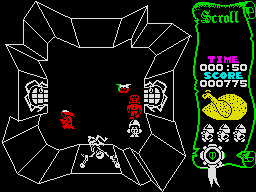 There are somewhat over two hundred rooms in the castle,
spread over five floors. As a rule, lower floor = higher danger, and the only
way out of the castle is by assembling a three-part key. If all you had to do was traipse around until
you found them, it would be a very straightforward operation. As you might expect, though, there is a fair
amount of danger lurking, usually in shadows, coffins, and so forth. In the basement it is possible to run into
Dracula and/or Frankenstein’s monster, which is unlikely to do you a lot of
good, and creatures who generally don’t like you will attack at every
opportunity. The player must also eat
constantly. The health of the wily
wizard or brave knight or plucky serf you have chosen to play is indicated by a
roast chicken graphic on the right of the screen. The weaker the player becomes – either
through hunger or attack – the less meaty and more bony the chicken
becomes. When your chicken is all bones
and no meat, you lose a life. This novel
feature drew enthusiastic plaudits at the time, and has been widely imitated
ever since. Why food would be left
scattered around a building inhabited by beings that are already dead is
anyone’s guess, but eating it meated up your chicken carcass and kept you going
for longer.
The player can power up, of course, even though the phrase
had not been invented at the time. This
was achieved by collecting additional weapons or spells which have presumably
been left lying around by careless spooks and ghouls. Also, there are time warp generators which
can deposit the player in other locations in the castle, and locked doors which
can only be opened with the correctly coloured key. A feature of gameplay was the little
headstone graphic that would sprout wherever a player lost a life. Players quickly learned that these markers
were a useful starting point for mapping the castle, which was essential to
cracking the game.
Interestingly, it was recommended that players spurn
new-fangled joysticks in favour of keyboard control for this epic subterranean
explore-a-thon, as the game could take so long to complete that even the
sturdiest moulded plastic hand control would break under the strain. Whether or not this was true is immaterial:
in 1983, £5.50 spent in the new gaming racks at Our Price would buy you into an
absorbing and hugely atmospheric world, and keep you barricaded into your room
until you discovered the Smiths.
The Stamper brothers would later invent the process by which
graphics information is compressed into cartridge format, an idea which they
flogged to Nintendo for trillions and trillions of pounds. Arguably, this had for more impact upon
gaming and popular culture in general than blundering around a wire frame
dungeon eating endless chicken legs, but trails are best blazed one at a time.
Comments are closed.