
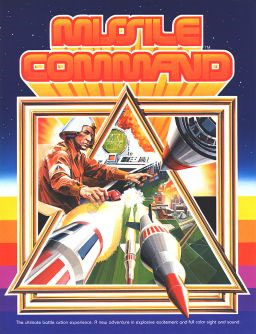
 People were obsessed with impending nuclear Armageddon in the 1980’s, presumably as a way to take their minds off the awful music and rubbish clothes. However, even in 1980, with Two Tone dominating the charts, the mod revival in full swing and the decade still quite fresh and exciting – apart from all the rioting – Chicago student and technology tinkerer David Theurer was a troubled young man. Obsessed by ghastly recurring nightmares in which neighbouring cities were wiped out by atom bombs, and strongly influenced by American attempts to train pigeons for military purposes in World War Two, he set about writing computer games.
Theurer claims that the pigeon training stuff was gleaned while studying for a psychology degree, and came in handy when creating addictive computer games. While this may or may not be true, he was certainly adept at turning horrific dreams into arcade gold: another common nocturnal frightfest involved decomposing bodies emerging from holes in the ground to attack him, which formed the basis of Tempest.
So, putting aside the belated advice that it might have been an idea for him to switch from cheese sandwiches to cocoa before bedtime, let’s prepare to release the launch codes, paint the living room windows white, and go to DefCon 1 as we embrace the starkly marvellous world of Missile Command.
There’s not a lot to it. Partly because, in 1980, making the word ‘boobless’ appear on a pocket calculator was considered cutting edge microchip japery, but also because there simply doesn’t need to be. This is a theme we have returned to time and again while considering the first generation of arcade games: they had to marry a simple premise with good gameplay and immaculate execution in order to succeed. Missile Command is a screen, a tracker ball, and a firing button. Incoming missiles drift towards your defenceless cities. Using your tracker ball and firing button, you counter this with surface to air ordnance. Your missiles need to explode near their missiles to neutralise them. Job done.
 There is a brilliantly subtle twist, however. You fire from three launchers, each of which only has ten missiles. This is not enough ammo to keep all the enemy firepower at bay, even on the initial screens. It is therefore necessary to wipe out several incoming bad guys at once – which is entirely possible, as they are slow moving and leave handy contrails all over the screen to indicate direction and speed. Inevitably, the player ends up having to play a highly tactical game, deciding which cities to save and which to sacrifice, rather like – and this must have crossed the darker recesses of Theurer’s slumbering mind – a real life nuclear war scenario. As you might expect, things get trickier at higher levels with the introduction of smart bombs, which require absolute accuracy to destroy. Ultimately you lose, as the game goes on and on for level after level until your cities eventually succumb to the onslaught.
The all time high score for a single coin game of Missile Command is a retina damaging 80,364,995 set in 1982 by a Victor Ali, who presumably went nuts afterwards, considering that destroying each enemy missile only nets 150 points.
Missile Command is very much a child of its time, rooted in Cold War paranoia and fears about atomic holocaust. Contemporary games – featuring the elimination of terrorist cells, for example – may one day be regarded in the same light. It remains to be seen what underlying global threats will shape popular gaming in the next thirty years – let’s just hope there are still people around to write entertaining digital code about them. Don’t have nightmares.
Comments are closed.