
 The ideal place for storing state secrets in the post Cold War era is on laptop computers, which are then placed in briefcases and left in random places upon the public transport networks of Southern England.
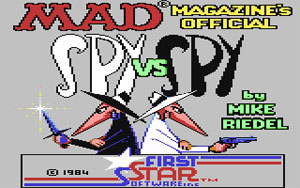
In the Eighties it was a very different kettle of coconuts. With the ever present threat of nuclear oblivion and massive ideologically exclusive armies poised to hurl themselves at each other across the European landmass, things were rather more watertight. Obscure software house First Star Software decided that the best way to represent this global powder keg was by having a couple of pointy faced fools chasing each other around a split level video game. For those of you who might want to introduce a trick question into a very dorky indeed pub quiz, it definitely was Spy Vs. Spy that has the accolade of being the first split level game. Motor racing trailblazer Pit Stop 2 usually claims this title; however, while its split screen was certainly the first in development, Spy vs. Spy was the first to mix it up in Woolworths with the Thompson Twins 12 inch singles and Return Of The Jedi trading cards.
The game is subtle and highly entertaining, and can indeed only really work in this split level format. Two spies – one clad in black and one in white, but both looking strangely like fetishists of some kind – attempt to do each other in with a variety of improbable booby traps while assembling, in later variants anyway, a large missile. They had been doing this in a comic strip featured in unfunny American comedy magazine Mad for thirty years, with each spy being equally ruthless and, ultimately, unsuccessful in dominating the other, and the plot of the video game was a faithful reproduction of their papery self-perpetuating struggle.
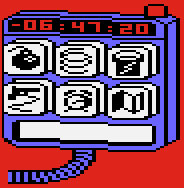 The game centres around the setting of traps. These traps ensnare the opponent, force them to drop any items salient to the completion of the game that they might have collected, and incur a time penalty. There are a lot of traps available to the player, and each trap can be rendered safe with the deployment of the correct countermeasures. For example, a dynamite trap can be countered with a bucket of water. Gun and string traps can be deactivated with scissors. A giant spring trap can be avoided with the swift use of wire cutters. Electricity traps with rubber boots, water bucket traps with umbrellas, and so forth. However, a time bomb trap cannot be safely detonated, and will require some judicious running away on the part of the spy who will have found that his character’s face has turned blue, which is the only warning of such a nefarious device.
While this all sounds pretty straightforward, there is a real strategy element in Spy vs. Spy. Action takes place in a pseudo military/scientific installation, with each room forming part of a far larger floor plan. The real genius aspect, though, is that traps can be set off by either player. This means that players must try and remember where they have placed their traps to avoid stitching themselves up like kippers. And don’t go thinking you can just write them down on a Hill Street Blues A4 pad, either, as the game is against the clock and there is no pause function. Players commonly divide the floor plan into a grid, with perhaps water traps being placed in odd numbered rooms, and electricity traps in even numbered ones, or some similar ‘code’. Part of the skill of the two player game – and really, Spy vs. Spy has to be played by two players to fully appreciate this simple, fantastic strategic twist – is guessing what system an opponent is using in order to win.
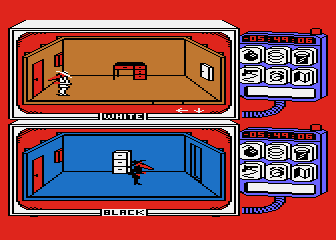 There was an unscrupulous but valid way to win early versions of the games by heavily trapping the final room of the complex, which players must enter with their full complement of key items in order to carry the day. When the traps were triggered, the opposing player would rush in, gather up the key items subsequently dropped by the now briefly incapacitated rival spy, and win. It could be argued that in a game that encouraged sneakiness of thought, this tactic was a masterstroke. Due to the stalemate that occurred when two players employed it at once, First Star recoded part of the game to ensure it couldn’t happen.
Spy vs. Spy has popped up all over the place in popular culture. The term itself has entered the vernacular as a byword for mutually nullifying activity, Essex political song man Billy Bragg released an album entitled Life’s A Riot With Spy Vs Spy, and Toyota made a series of adverts based upon the game called Yaris vs. Yaris. The strip itself continues to appear in Mad Magazine, and was the subject of a parody by the good people from Sonic the Hedgehog, in which the spiky hero defeats both spies with the help of a Dr Eggman trap, in a sequence of events which is outlandish and very wrong.
So that’s Spy vs. Spy. Perhaps not the best fun you can have while dressed in fetish clothing, but excellent in more than enough ways to compensate.
Comments are closed.