

The phrase ‘classic is a phrase that is used too much these days’ is, in turn, a phrase that is used too much these days. Civilisation 2, however, is a classic in the literal sense. It’s also an epic in the Homeric sense, and genius in the Archemedian sense. It was the first of the really big strategy games that you didn’t so much play as marry. This article is late because, in the interests of research, I decided to download a copy of the old time guzzler for a quick half hour blast and effectively deleted Wednesday October 21st 2009 from my life.
But no matter. The Civilisation franchise is one of the cornerstones of modern strategy gaming, along with the Sim City, Railroad Tycoon and Total War famlies, and everyone with even the vaguest interest in the genre will, at some point, feel the embrace of this migraine-inducing mistress.
The aim of Civ2 is to nurse your small wandering tribe of pre-historic also-rans into an uber-advanced, industrial-military powerhouse over the course of about eight thousand years. So, if you’ve booked your annual leave, bid adieu to your loved ones and stocked up on food that requires no preparation, brace yourself to go right back to the beginning of everything, ever, and start history all over again. It’s a bit of an ask, to say the least, so we’d best crack on.
Civ2 is not, as sharp eyed readers will doubtless already have realised, the first in the franchise. In fact it all started – probably – with a boardgame, of which more later. However, Civ2 brought the three strands of the game – trade, technology and military expansion – together so beautifully as to render Civ1 obselete in about nine seconds. So what, precisely, is all the fuss about?
Well, firstly you pick your civilisation. All the usual suspects are available – the English, the Russians, the Germans, the Chinese – as well as the Aztecs, the Romans and the Zulus, if you fancy mixing things up a bit. There are no specialist unit types or any such palaver in the Civ series, and the various peoples have no specific characteristics beyond city names and building types.
Having sorted that out, things get a bit fiddly. You need to turn your shambling cave dwellers into people who understand the concept of doors and haircuts, quick sharp. Therefore, cities need to be built. Location of these is of paramount importance – you need arable land, a river or access to the sea is never a bad thing, either. Every great city in the actual world sprang up along flood plains or major waterways, and it’s no different here. Make things cohesive by connecting your cities with roads and, much later on, railways. Irrigate the surrounding land. Grow crops. Create a surplus of food with which to produce other settlers, and so on until you have created a bona fide nation.
Probably the most crucial thing you’ll need to bear in mind while plonking cities all over the place is what your egg heads are doing. Scientific advancement is massively important, and with the technology tree starting at pottery and ending with genetic engineering, the lab coat bods will be chained to the abacus straight from kick off. If you’ve done your city planning correctly, a productive workforce with a decent boffin ratio will be building Wonders of the World before long, from the Oracle at Delphi to the SETI Program, all of which bring pleasing and potentially game-winning benefits.
Of course, you can’t make an omelette without breaking eggs, and it will be war eggs from which your civilisation’s conquest omelette will be prepared. A decent military presence is vital if you want to persuade rival civilisations that you are more Viking than monastery. Seeing as your war machine is technologically linked, it is not uncommon to find your gallant musketeers being annihilated by enemy stealth bombers if you’ve let things slide. If you don’t fancy playing a straight bat, the canny but militarily weak player can employ spies, treachery and general underhandedness to steal technologies, bribe enemy units or even cause insurrections in enemy cities. Or you can send your diplomatic staff in – deft political sleight of hand can pacify even the most tyrannical of tyrants.
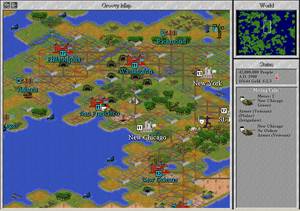 With all these things going on, there are any number of ways to win – and lose – this game. We’ve not even mentioned trade yet, which can inflict economic warfare upon opponants from afar, or the space race, or the different government types you might want to consider, from Despot to Democratic. There is just so much stuff to consider.
Brilliant computer games man Sid Meier, who formed the Firaxis publishing house and released the series, claims somewhat murkily not to have been influenced by the earlier Civilisation boardgame, despite his colleagues stating that he not only owned a copy but played it throughout the development stages. There are certainly a few tell tale similiarities: the name, for one, the overall premise of the game for two, and the publishing in 2002 of Sid Meier’s Civilisation: the Boardgame, for three. Happily, the original Civilisation game retains a large cult following and Avalon Hill, who published it, have done very nicely thankyou from the reflected glory of Sid Meier and his selective memory.
So there we are. This game is amazing and it’s worth sacrificing a few of your minor real life relationships for. Last one to discover the Theory of Gravity is a pansy.
Comments are closed.